 Vastram
It's 9 PM on a Thursday. A bride-to-be is standing at your counter with her mother and her future mother-in-law, trying on a heavily embroidered maroon lehenga for a wedding that's eleven days away. Everyone loves it. You flip open the register, find the page for that date range, scan down the column of names — and there it is, in your own handwriting from three weeks ago: the same lehenga, already promised to someone else for a wedding two days before this one.
You have two options now. Tell the family in front of you that the lehenga they just fell in love with isn't actually available, and watch the mother-in-law's face change in real time. Or call the other customer and try to talk them into a different outfit, eleven days before their own wedding, and hope they don't walk out of your relationship with the shop entirely.
Neither option is good. And if you've run a boutique rental business for any length of time, you've lived through some version of this exact moment — not because you're careless, but because a handwritten register and a phone full of WhatsApp chats were never built to answer one simple question reliably: is this specific outfit actually free on these specific dates?
This guide is about why that question is harder than it looks, what it actually costs a rental business when the answer is wrong, and what a boutique owner in Surat, Jaipur, Ahmedabad, or anywhere else running this kind of business needs in place to stop it from happening — regardless of what software you end up using to do it.
Why rental is a fundamentally different business than retail
Most billing and inventory software sold in India is built around retail logic: you buy stock, you sell it once, the sale is the end of the story. A saree shop that sells sarees outright can run on almost anything — a basic billing app, even a well-organized Excel sheet — because once an item is sold, it's gone. There's no second customer to double-book it against.
A rental business doesn't work that way. The same lehenga goes out and comes back, over and over, sometimes dozens of times across its working life. Every single rental creates a window of unavailability — a start date and an end date during which that specific physical item, not just "a lehenga like this one," cannot be promised to anyone else. And because most boutiques carry multiple sizes, colors, and near-duplicates of popular styles, keeping track of which exact piece is free on which exact date, across a catalog that might run into hundreds of items, is a fundamentally harder tracking problem than retail ever has to solve.
On top of that, a rental business has several other moving parts retail never deals with at all:
- Security deposits that have to be collected, tracked, and partially or fully refunded depending on the condition the item comes back in.
- Damage and late-return charges that need to be calculated fairly and explained clearly, or they become the thing customers complain about on Instagram.
- Wash and maintenance cycles — an item that's just been returned usually can't go straight back into the available pool; it needs to be cleaned first, and if your system doesn't know that, it'll happily let someone book it for tomorrow.
- Multi-item bookings — a single wedding booking is rarely just one lehenga. It's the outfit, the dupatta, sometimes jewelry, sometimes a matching sherwani for the groom's side, each potentially needing its own pickup and return schedule.
None of this is exotic. It's just the normal, daily reality of running a rental shop. But it means the tools built for retail — and the mental math of tracking it all in a register — genuinely aren't built for what you're actually doing.
What the old way actually costs you
It's worth being specific about this, because "use a better system" sounds like generic advice until you count what the old way is quietly taking from the business every month.
Double bookings cost you more than one customer. When you have to call someone and tell them the outfit they were promised isn't available anymore, you don't just lose that booking — you lose the trust that made them book with you in the first place, and in a business that runs heavily on word-of-mouth and repeat customers for weddings and festival season, that trust is the actual product you're selling. One bad double-booking story travels through a family's wedding-planning WhatsApp group faster than any advertisement you could run.
Missed returns delay the next booking, which cascades. If a sherwani is supposed to come back on Tuesday and nobody's actively tracking that, it often doesn't get followed up on until someone else needs it Thursday — and now you're calling a customer to ask, slightly awkwardly, if they can return something a day early, or worse, telling the next customer there's a delay.
Handwritten bills don't look professional, and professionalism affects pricing power. A boutique that hands over a scribbled chit for a ₹15,000 lehenga rental is signaling something different than one that sends a clean, branded, itemized PDF invoice straight to the customer's WhatsApp. Customers extend more trust — and tolerate higher prices — for businesses that look like they have their act together.
You genuinely don't know which pieces are making you money. This is the one most owners underestimate. If you spent ₹50,000 on a bridal lehenga, has it paid for itself yet? Most boutique owners running on paper can't answer that question without sitting down and manually adding up every booking that item has ever had — so in practice, nobody does the math, and the business keeps buying new stock on instinct rather than on actual performance data.
The building blocks of a rental business that doesn't fall apart
None of what follows requires any specific piece of software. It's the actual system — the set of questions your process needs to be able to answer instantly, every time — that a boutique rental business needs to have in place. How you implement it (a very disciplined paper system, a spreadsheet, or purpose-built software) is a separate decision from whether you have it.
1. A real digital catalog, not a mental one
Every item you rent out needs to exist somewhere as a record — with a photo, a name or code, a rent price, a deposit amount, and a current status (available, currently rented, in wash, under repair, or retired from the rotation). This sounds basic, but it's the foundation everything else is built on. If your "catalog" is really just your own memory of what's in the back room, nobody else who works the counter can make a confident promise to a customer, and you can't be in two places at once during wedding season.
2. Booking and availability that actually checks, not assumes
This is the core of the double-booking problem, and it's worth being precise about what "checking availability" actually means. It's not enough to glance at a calendar page for the date someone's asking about — you need the system (paper or digital) to cross-reference the specific item against every other booking that overlaps those dates, including bookings made by anyone else on staff, on any device, at any time before this moment.
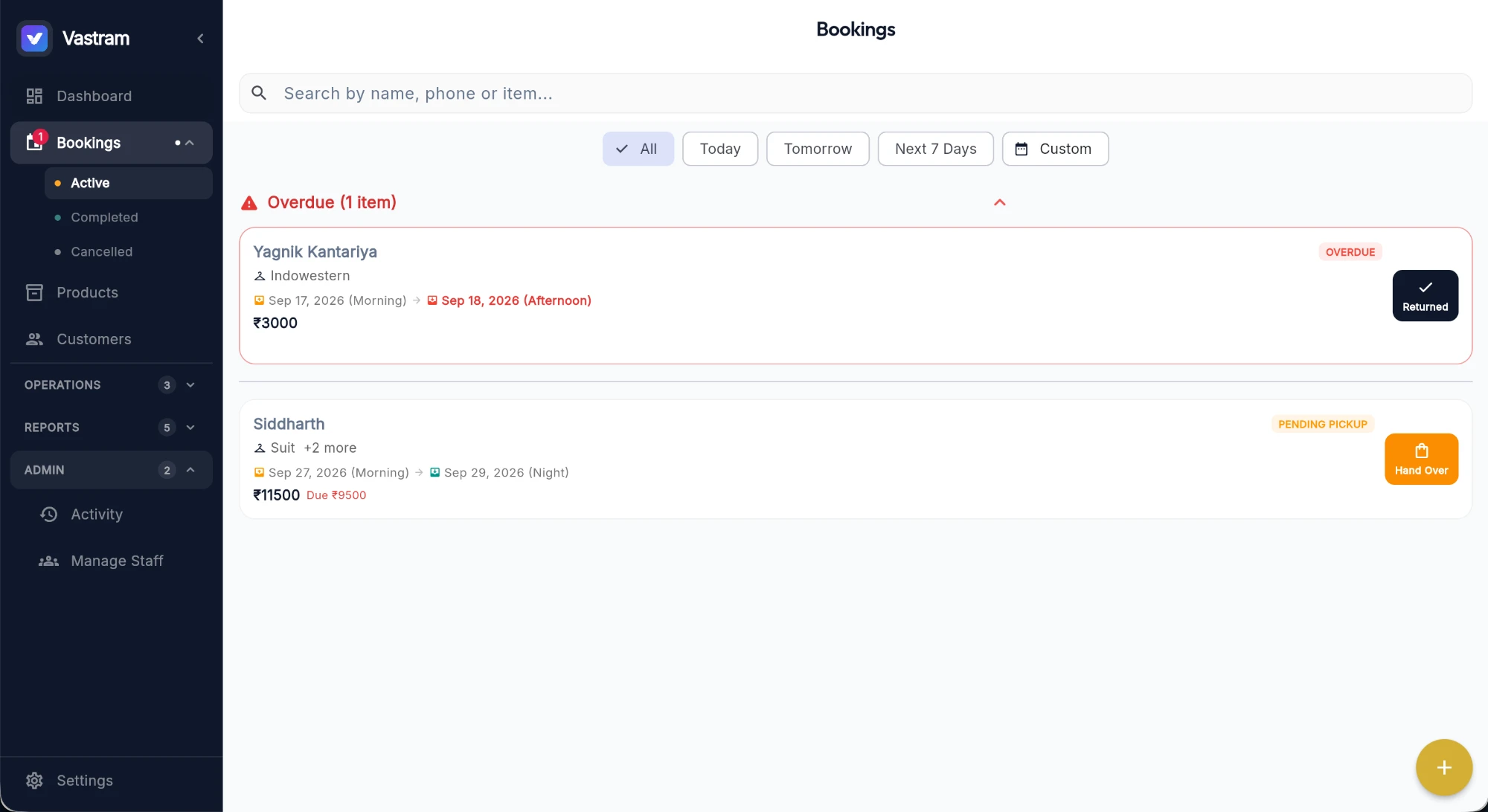
This is exactly where a shared, real-time system earns its keep over a register: two staff members working the same busy Saturday, on two different phones, both trying to book the same sherwani for overlapping dates, need to get stopped at the moment of booking — not discovered three weeks later when both customers show up.
3. Security deposits and damage settlement, done consistently
Every rental business needs a clear, repeatable process for what happens when an item comes back: how much deposit was collected, what (if anything) needs to be deducted for damage or a late return, and what the final refund or balance due actually comes out to. The business risk here isn't usually that owners are unfair about it — it's that an inconsistent process, where the deduction logic is different every time because it's being worked out from memory, erodes customer trust and occasionally costs the shop money it should have collected.
A good settlement process is also fast. A customer standing at the counter returning an outfit shouldn't be waiting while someone mentally reconstructs what was agreed on weeks earlier.
4. Invoicing that goes where your customers actually are
In most of India, and especially for a business built on family referrals and wedding bookings, WhatsApp isn't a nice-to-have delivery channel for a bill — it's the primary one. Customers expect to receive a clean, itemized, properly branded invoice the same way they'd receive a photo from a family member: instantly, on WhatsApp, with no back-and-forth.
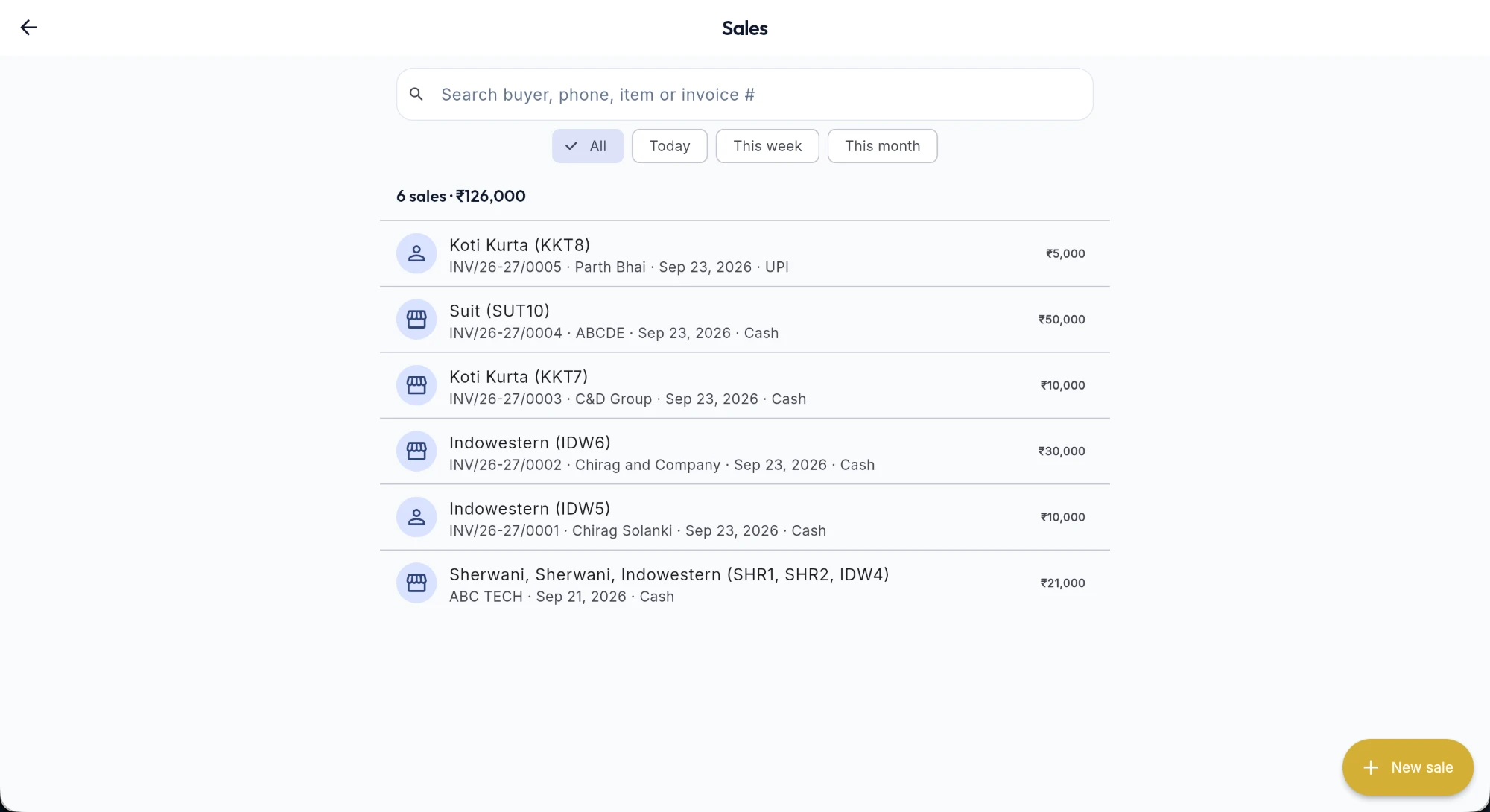
A proper invoice — not a handwritten chit — should carry your logo, your GST number if you have one, an itemized breakdown of what was rented, the advance paid, the deposit collected, and the balance due. It's a small thing that quietly changes how professional the entire transaction feels.
5. A daily operating view — pickups, returns, and overdue items, in one place
Every morning, before the shop even opens, whoever is running the counter needs to be able to answer three questions in under thirty seconds: what's being picked up today, what's due back today, and what's already overdue. Without a dashboard answering this automatically, that information lives scattered across a register, a diary, and whoever happens to remember.
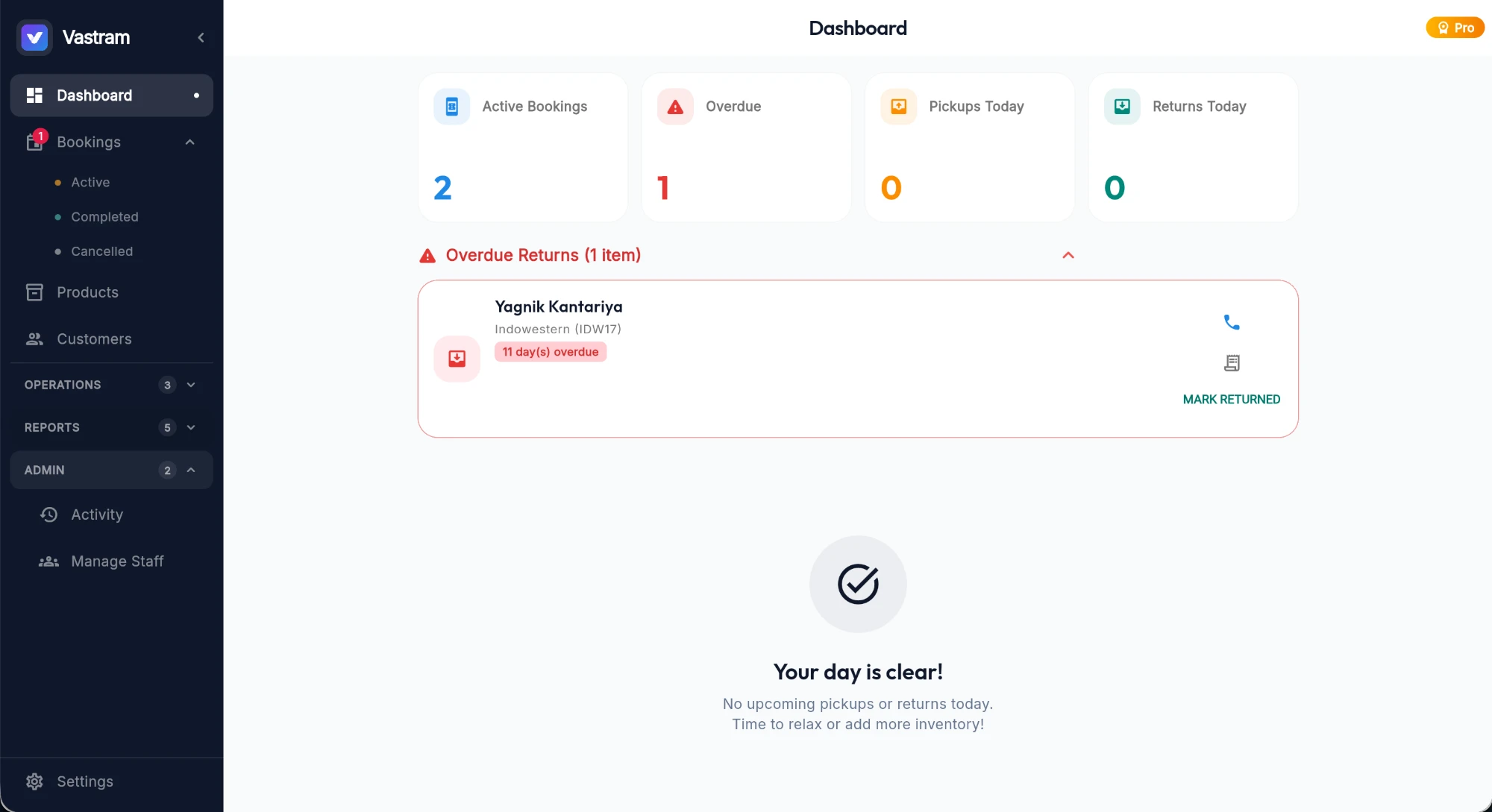
This is also where overdue returns need to be impossible to quietly miss. An item that's two days late isn't just a scheduling inconvenience — it's inventory you can't promise to the next customer, and every day it stays untracked is a day closer to a second double-booking, not just a first one.
6. Knowing your actual numbers, not just your bookings
This is the piece most boutique rental businesses never get to, because by the time they've solved double-bookings and deposits and invoicing, there's no energy left for financial tracking — so it stays in a separate notebook, or in nobody's head at all. But a rental business genuinely runs better when the owner can see:
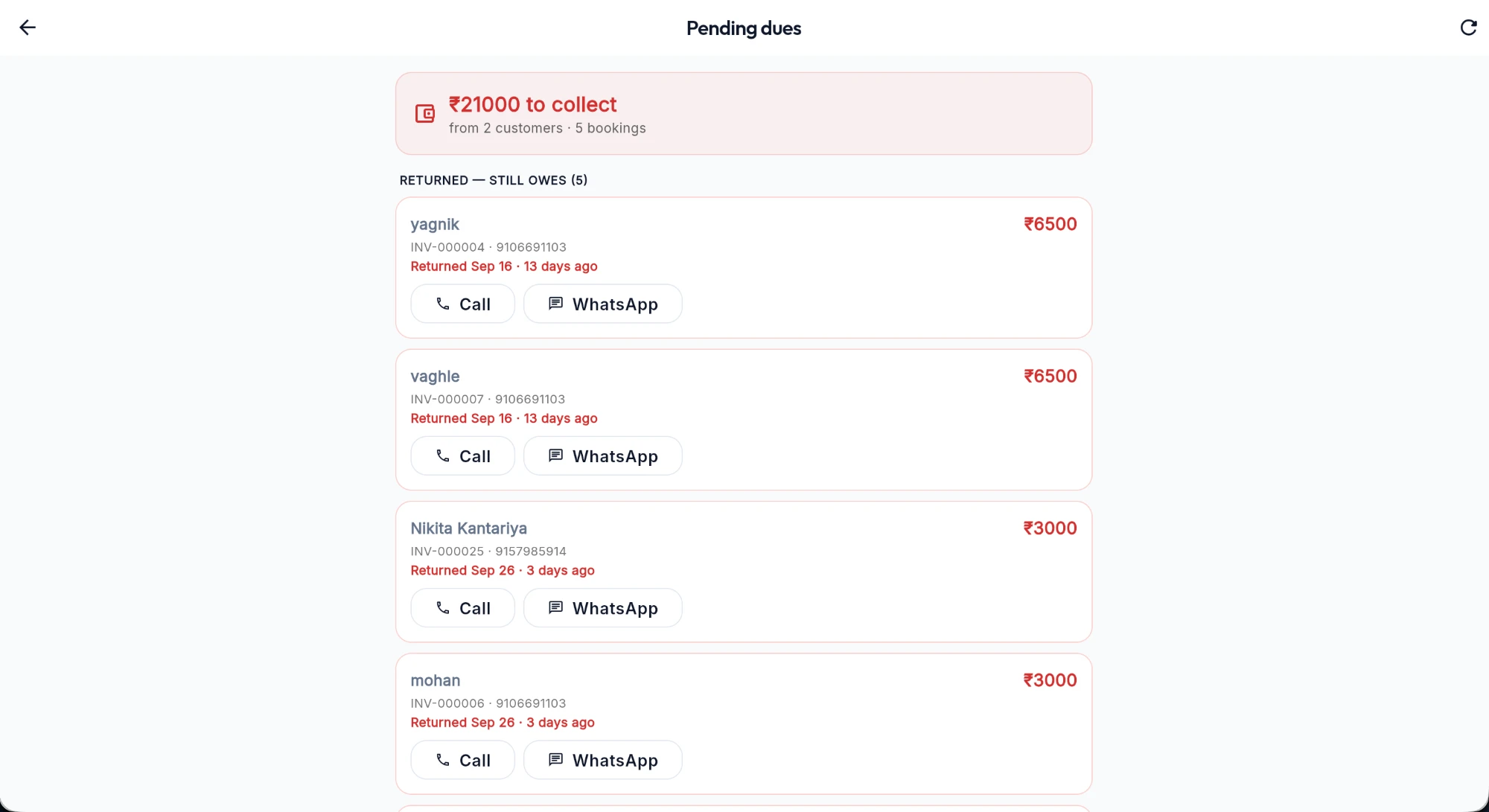
What's actually owed to you. Every return where the balance wasn't fully collected at hand-over needs to be tracked somewhere a human will actually look at it again, not buried in a pile of paper invoices.
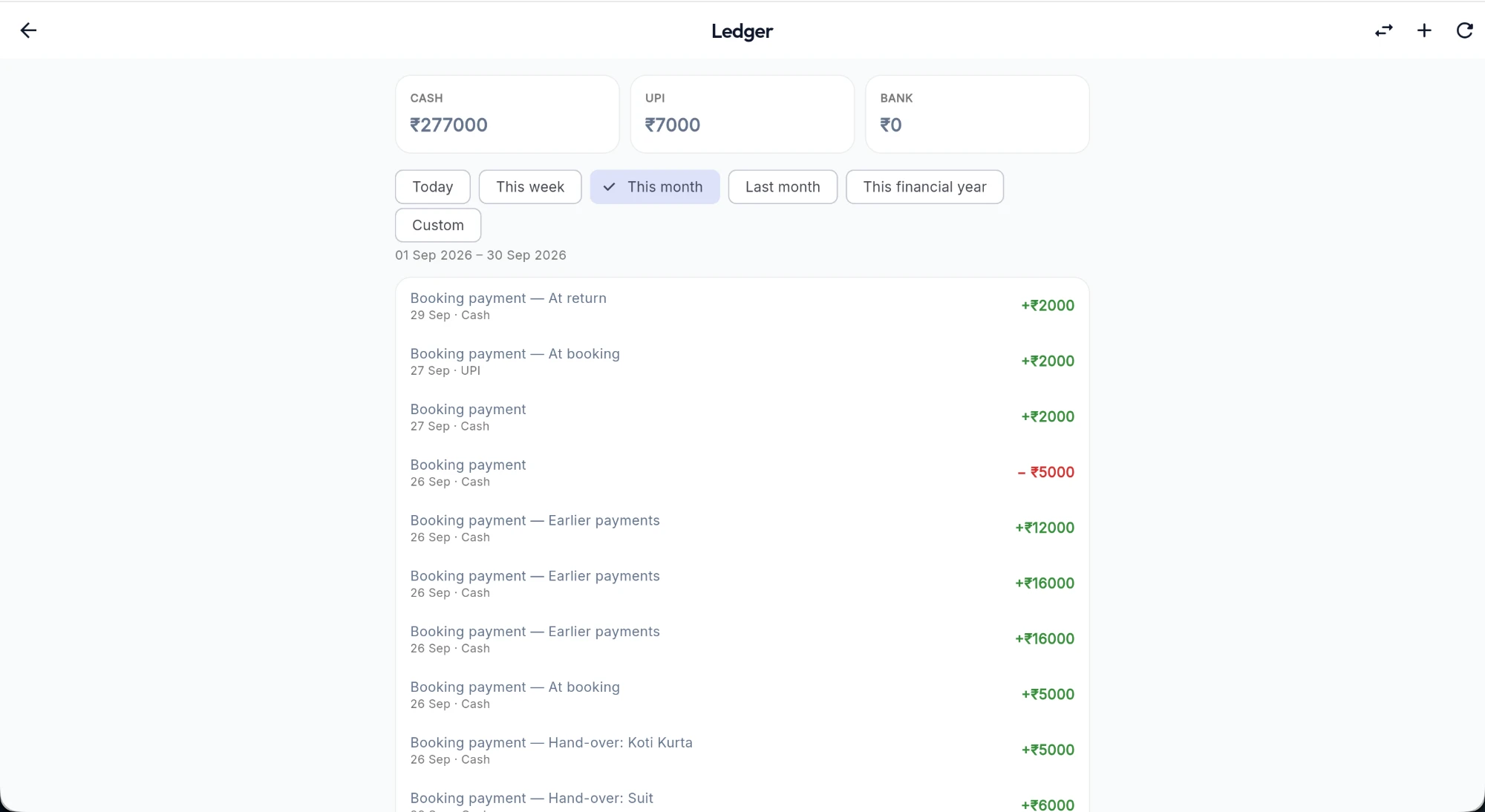
Where your cash actually sits. Cash in the till, UPI payments, bank transfers — these all need to be tracked as separate, reconcilable totals, not mentally merged into one vague "money" number that's impossible to audit at the end of the month.
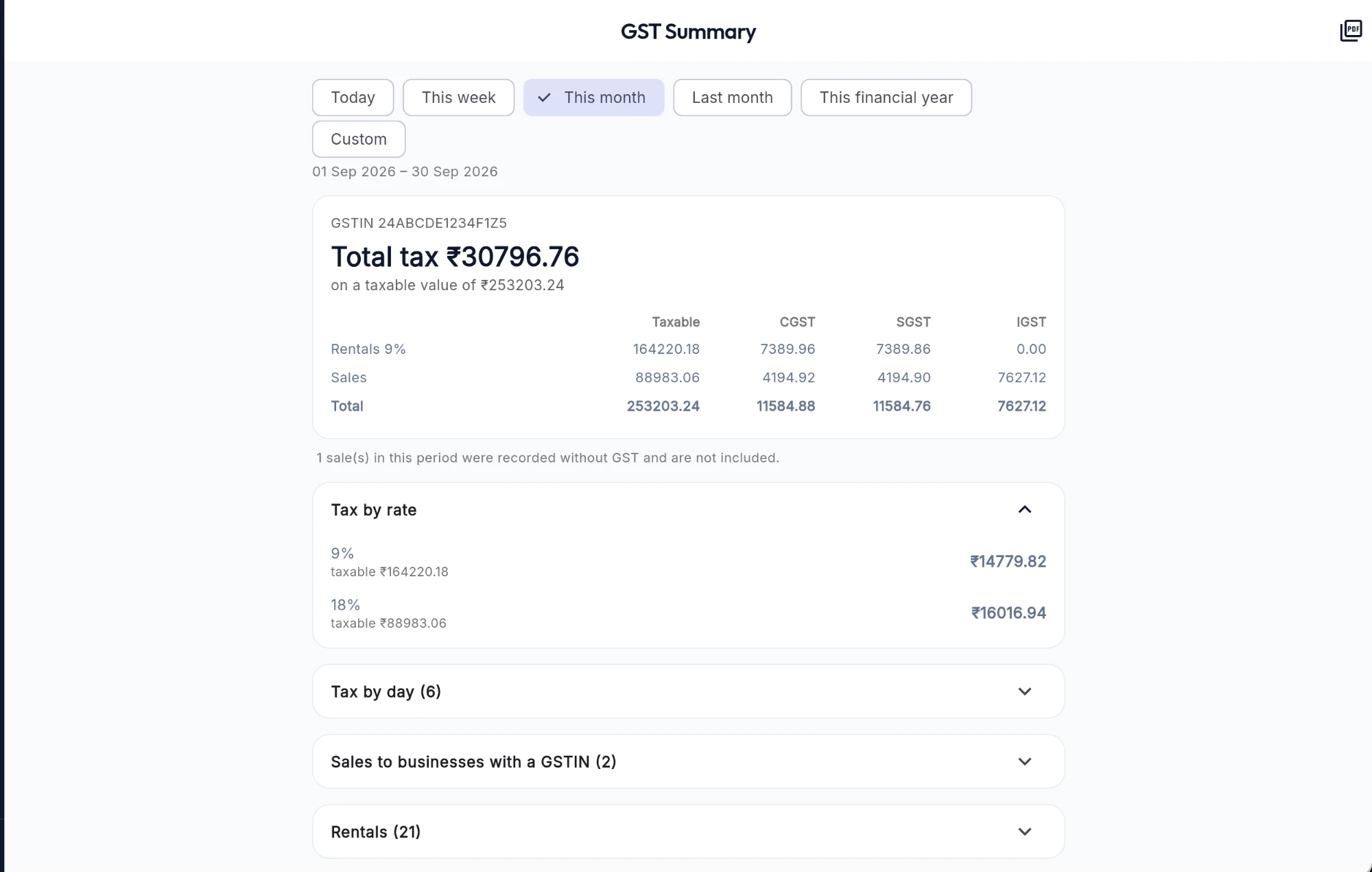
What your GST liability actually is. If you're registered for GST — and if you sell outfits outright in addition to renting them, this matters even more — you need rentals and sales broken down by tax rate, ready to hand to a CA without reformatting anything by hand at filing time.
Which pieces are actually earning their keep. This is the number that changes how you buy stock. An item's cost versus what it's earned, visible per piece, tells you plainly whether that ₹50,000 bridal lehenga has paid for itself yet — and whether it's worth buying three more like it, or whether that category just isn't moving the way you assumed it was.
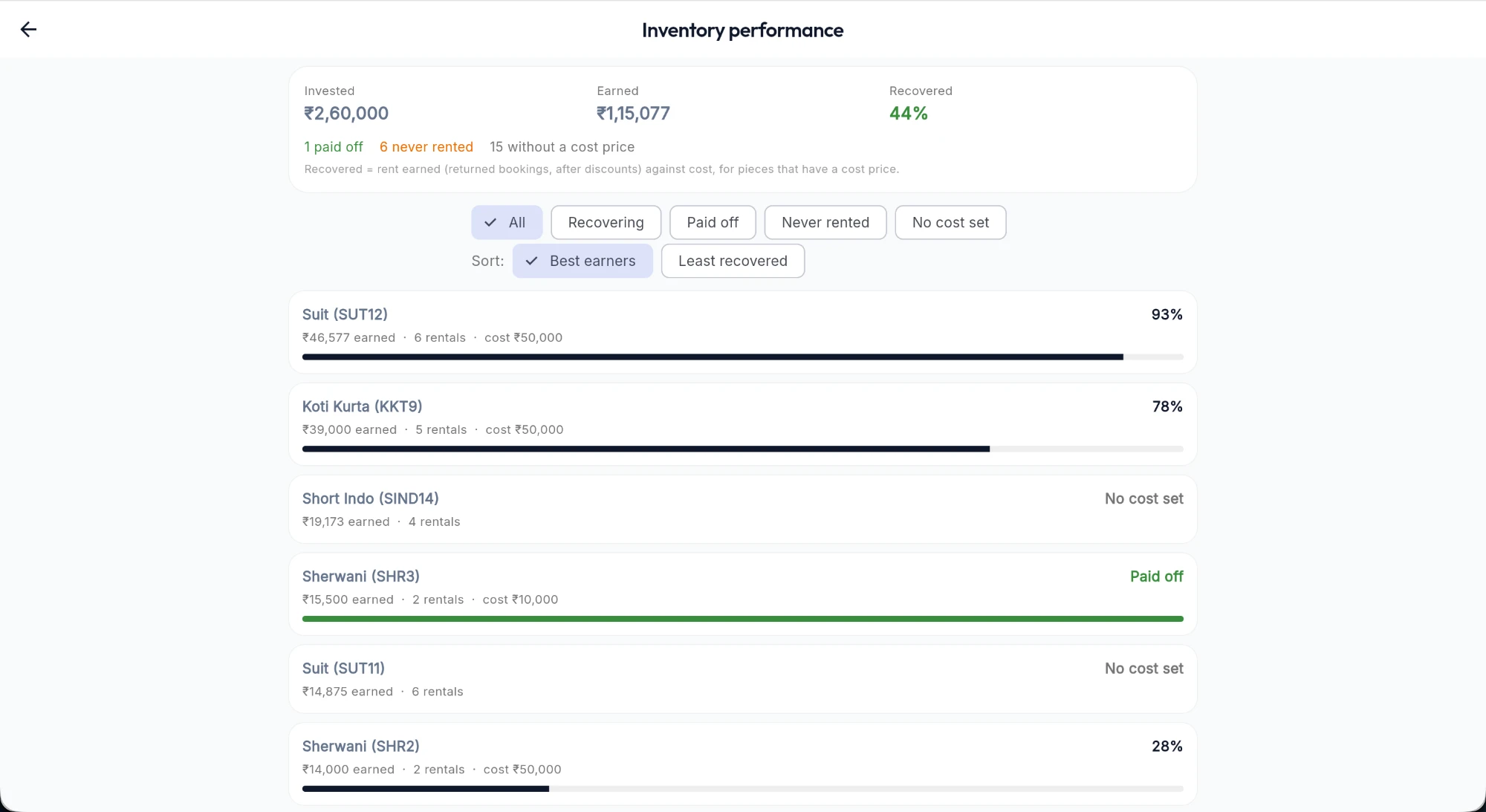
A boutique that can see all of this clearly isn't just better organized — it's making real purchasing and pricing decisions off actual data instead of instinct, which compounds over every wedding season.
What a single booking actually looks like, start to finish
It helps to walk through one real booking end to end, because this is where all six building blocks above stop being separate ideas and start being one continuous process.
A customer calls about a lehenga for a wedding three weeks out. Before anything else gets promised, whoever's on the phone checks that specific piece against every other booking that overlaps those dates — not "do we have something like this," but that exact item, those exact dates. If it's clear, the booking gets created immediately, with the pickup date, the return date, and the event date itself (which often isn't the same as the pickup date — outfits usually go out a day or two early for last-minute alterations). If the family also wants a matching dupatta or jewelry, that gets added to the same booking rather than becoming a second, disconnected transaction — one bill, one pickup, one return, for the whole set.
At this point an advance gets collected, along with the security deposit, and both get recorded against the booking — not scribbled on a separate chit that might not make it back to the main register. The customer's name, phone number, and address get saved too, which matters more than it sounds like it would: the second time this family books with you, for the groom's sherwani or for a sister's outfit next year, you already have their history instead of starting from nothing.
On the pickup date, the item gets handed over, and the invoice goes out the same way the customer expects to receive anything else important — on WhatsApp, as a proper branded PDF, not a photo of a handwritten page. When the outfit comes back, the settlement happens on the spot: any damage deduction or late fee gets applied against the deposit using the same rule you'd apply to anyone else, the final refund or balance gets calculated immediately instead of "we'll figure it out," and the item either goes back into the available pool or, if it needs cleaning first, gets marked as unavailable until it's actually ready — so nobody accidentally promises a piece that's still at the dry cleaner.
Every part of that sequence — the availability check, the multi-item booking, the deposit, the WhatsApp invoice, the settlement, the wash status — is a place where a paper-and-WhatsApp process has a gap a busy Saturday can slip through. None of the individual steps are hard. The difficulty is doing all of them, correctly, every single time, for every booking, during the exact weeks of the year when the shop is busiest and attention is most stretched.
The seasonal reality: why this matters most when it's hardest to get right
Boutique rental businesses in India don't run at a steady pace year-round — they spike hard around wedding season and major festivals, and that's precisely when the gaps in a paper-based system cause the most damage. The counter is busier, more than one staff member is working bookings simultaneously, customers are making decisions under their own time pressure, and the sheer volume of bookings per day goes up by multiples.
This is worth naming directly because it changes how you should think about "being careful enough." A process that works fine in a quiet month — checking a register, remembering what's out, settling deposits from memory — doesn't automatically scale to a month where you're doing five times the bookings with the same number of staff. The system that protects you isn't the one that works when things are calm. It's the one that still works at 9 PM on a Saturday in November, with three families waiting and two staff members both reaching for the same register.
The mistakes that quietly cost rental shops the most
A few patterns show up again and again in boutiques that are still running into double-bookings and cash-flow confusion, even after years in business:
Trusting memory over a system, "just this once." Almost every double-booking story starts with a version of "I knew it was free, I didn't need to check." The register or the app only protects you if checking it is the habit, every single time, even during the busiest, most chaotic hour of wedding season — especially then, actually, since that's exactly when memory is least reliable and the stakes are highest.
Letting staff work from different sources of truth. If one staff member is checking a physical register and another is going off what they remember from a conversation that morning, you don't actually have one system — you have two, quietly disagreeing with each other, and a double-booking is just a matter of time.
Treating deposit and damage settlement as a case-by-case judgment call. Without a consistent rule (even an informal one, like "a 200 rupee per day late fee, always"), every settlement conversation becomes a small negotiation, which is both slower and more likely to create a customer who feels they were treated differently than someone else.
Never actually sitting down with the numbers. It's easy to feel busy — booked out every weekend, a full shop — while still not knowing whether the business is actually profitable item by item. Busy and profitable aren't the same thing, and the only way to tell them apart is to periodically look at real numbers, not vibes.
A simple weekly rhythm that keeps all of this under control
You don't need an elaborate process to stay on top of a rental business — you need a short, consistent routine:
- Every morning: check what's due for pickup and return today, before a single customer walks in.
- Every return: settle the deposit and any deductions on the spot, using the same rule every time, and send the invoice immediately rather than "later."
- Every week: scan for anything overdue and follow up — a two-day-late return becomes much easier to resolve than a two-week-late one.
- Every month: look at pending dues, your GST summary if applicable, and which items are actually earning — not just how busy the shop felt.
None of this takes more than a few minutes a day if the information is already organized and visible. It takes considerably longer if it has to be reconstructed from a register every time.
What actually matters when choosing software for this
If you do decide to move off paper and WhatsApp, it's worth being specific about what to actually look for, because a lot of billing software marketed at small Indian businesses is retail software with a rental label added on top. A few honest questions to ask before committing to anything:
- Does it check availability against the specific physical item, or just a product category? Generic inventory counts aren't enough — you need per-item date conflict checking, which is a meaningfully different (and harder) thing to build correctly.
- Does it actually run from a phone, or is it a desktop tool that happens to load in a mobile browser? A counter conversation doesn't pause while you walk to a laptop.
- Does it handle the full rental cycle — deposits, damage deductions, wash tracking — or only the booking and the bill?
- Can it hand your CA a GST-ready report without you reformatting anything?
- Does it work in the language your staff actually thinks in? A tool that only works in English creates a translation step for every staff member who's more comfortable in Gujarati, Hindi, or another regional language — friction that adds up across hundreds of bookings a month.
Frequently asked questions
Why do double-bookings keep happening even when I'm careful? Because the real failure point usually isn't carelessness — it's a system (a register, scattered WhatsApp chats, staff memory) that can't be checked fast enough, by everyone, every single time, especially under the time pressure of a busy counter. The fix is a shared, always-current source of truth that anyone on staff can check in seconds, not a reminder to "be more careful."
How much should I charge for a security deposit? There's no universal number — it depends on the item's replacement cost and your own risk tolerance — but whatever percentage or flat amount you land on, the important thing is applying it consistently, so customers aren't comparing notes and finding the rule changed between their visit and a friend's.
Do I need GST registration to run a rental business? That depends on your turnover and is worth confirming with a CA rather than general advice — but if you are registered, your systems need to separate rental income and any outright sales by the correct tax rate from day one, not reconstruct it at filing time.
What's the difference between tracking "inventory" and tracking "availability"? Inventory tells you what you own. Availability tells you what's actually free on a specific future date range. A rental business lives or dies on the second one — you can own a hundred lehengas and still double-book one of them if nothing is checking date-level availability per item.
Is it worth digitizing if I only have a small catalog? Scale changes how often double-bookings happen, not whether they're possible. A ten-item catalog can still double-book an item if two people are checking two different sources of truth. The size of the fix should match the size of the real risk, not the size of the shop.
Should I rent or sell a piece once it's been through several bookings? This is exactly the question per-item earning data is meant to answer. Once a piece has recovered its cost many times over, the decision to keep renting it, retire it, or sell it outright stops being a guess — you can look at what it's actually earned and decide from there, rather than keeping every item in rotation indefinitely out of habit.
What should I do about a customer who disputes a damage deduction? Having a consistent, written-down rule — even an informal one you apply the same way every time — is the best protection here, because the conversation becomes "this is what we charge for this kind of damage" rather than a negotiation decided case by case. Photo evidence of the item's condition at handover and at return, kept with the booking, settles most disputes before they become arguments.
The actual point
None of this is really about software. It's about building a rental business where the answer to "is this specific outfit free on these specific dates" is never a guess, where a deposit settlement takes the same thirty seconds every time instead of a negotiation, and where, at the end of a wedding season, you can actually tell which pieces in your collection earned their place in it.
Vastram was built around exactly this list — real-time conflict checking per item, deposit and damage settlement, WhatsApp-native invoicing, and the financial reporting (sales, GST, pending dues, ledger, and per-item performance) that most rental software leaves out entirely — because it's the system we kept hearing boutique owners wished they'd had before the night a lehenga got promised to two brides at once. If you're curious what that looks like end to end, the features overview and a short demo are both a few clicks away.