 Vastram
Most boutique owners price a new lehenga the same way: look at what a nearby shop charges for something similar, round to a number that feels fair, and move on. It's not a bad starting instinct — but it's also not a system, and a shop with thirty or sixty or a hundred pieces priced this way usually has no real idea which ones are actually profitable and which ones are quietly losing money every time they go out the door.
This isn't about finding one "correct" price. It's about building a repeatable way to price — and periodically re-check the price of — every piece in your catalog, so the number on the tag is a decision, not a guess.
The ratio the market already uses
A useful starting anchor, grounded in how rental actually trades in India: a mid-range bridal or heavy-occasion lehenga that costs around ₹25,000 to acquire commonly rents for ₹4,000 to ₹4,500 per booking — roughly 16–18% of the piece's acquisition cost, per rental.
That ratio is a far more useful starting point than copying a flat number off a competitor's price list, because it scales with the piece. A ₹12,000 piece priced at the same ~16–18% ratio rents around ₹2,000–2,200. A ₹50,000 showpiece bridal lehenga, at the same ratio, would rent closer to ₹8,000–9,000 — though in practice, very high-value pieces often rent slightly below that proportional ratio, because the absolute price still has to feel reasonable to a customer even if the percentage dips. Treat 16–18% as the working baseline for your mid-tier catalog, and expect it to compress a little at the very top of your price range.
Price in tiers, not as one long list
Trying to price sixty individual pieces from scratch, one at a time, is how pricing drifts into inconsistency. A cleaner approach: group your catalog into three or four tiers by acquisition cost and occasion, and set a target rental percentage for each tier rather than a price for each item.
| Tier | Typical acquisition cost | Target rental ratio | Typical rental price |
|---|---|---|---|
| Everyday / sangeet | ₹8,000 – ₹15,000 | 18–20% | ₹1,500 – ₹3,000 |
| Mid-occasion | ₹15,000 – ₹30,000 | 16–18% | ₹2,500 – ₹5,000 |
| Premium / reception | ₹30,000 – ₹50,000 | 14–16% | ₹4,500 – ₹8,000 |
| Showpiece bridal | ₹50,000+ | 10–14% | ₹6,000 – ₹12,000+ |
Treat these as a starting framework, not a rulebook — your actual numbers should move based on your city, your competition, and (most importantly) real booking data once you have it. The value of tiering isn't the exact percentages; it's that every new piece gets priced by the same logic instead of each one being a fresh negotiation with yourself.
What a flat rental price quietly has to cover
The rental price isn't pure profit — it has to absorb several real costs that are easy to forget when you're setting a number, which is exactly why underpriced pieces can look busy and still barely break even:
- Cost recovery. The piece needs to earn back its own acquisition cost over its working lifetime, not just on one rental — this is the core of the ratio above.
- Cleaning, every single time. Dry cleaning or proper washing after each rental is a real, recurring cost, not an occasional one. If it's not priced in, it's coming straight out of margin on every booking.
- A damage and wear reserve. Even with careful customers, embroidery loosens, sequins fall, fabric wears thin over dozens of rentals. Pricing that assumes zero wear-and-tear cost is pricing that will eventually be wrong.
- Downtime. A piece that's in wash or awaiting a minor repair isn't earning. If a lehenga realistically only turns around fast enough for, say, 15–20 rentals a year rather than 30+, that caps how much total revenue it can generate — which matters when you're deciding how many pieces you actually need in a given tier.
- Alteration and fitting time, which is close to universal on bridal and heavy pieces and is real labor, even if it's your own.
None of these needs to be itemized to the customer — the rental price is still one number on the tag. But if you're setting that number without mentally accounting for all five, the price is lower than it should be, even when it looks competitive next to another shop's list.
A quick way to sanity-check any price
Before finalizing a new piece's rental price, it's worth running a rough gut-check: at your proposed price, how many rentals would it take to recover the acquisition cost alone (ignoring cleaning, damage reserve, and downtime, which only make the real number higher)? Using the ₹25,000 / ₹4,000–4,500 anchor above, that's roughly six rentals before the piece has paid for itself on cost alone.
If a price works out to needing twenty or thirty rentals just to break even on acquisition cost — which can happen if a piece is priced too low relative to what it cost to buy — that's a signal the price (or the piece itself, if it's an unusually high-cost item for its tier) needs a second look before it goes into rotation, not after a full season of underperformance.
Deposit sizing — the forgotten pricing lever
The security deposit isn't revenue, but getting it wrong in either direction has a real cost. A deposit set too low doesn't actually protect you if a piece is damaged or not returned — you're exposed for the difference. A deposit set too high, with no clear logic behind the number, can read as distrustful and cost you a booking to a shop with a more reasonable-looking policy.
The cleanest approach is tying the deposit to the piece's actual replacement cost, not a flat percentage applied uniformly across completely different price tiers. A ₹8,000 piece and a ₹50,000 piece carry very different real risk if something goes wrong — the deposit policy should reflect that difference, consistently, rather than being decided case by case at the counter (which is also the fastest way to end up with two customers comparing notes and finding the "rule" changed between their visits).
Pricing for demand, not just cost
Cost-recovery pricing sets the floor. Demand should move the price above it at predictable, known times of year — not randomly, which just confuses regular customers.
Wedding season and major festival windows are when demand for the same pieces spikes hardest — this is where it's reasonable to price at the top of a tier's range, or add a clearly-stated peak surcharge, rather than leaving wedding-season pricing identical to a slow Tuesday in July.
Same-week or urgent bookings for a high-demand piece are a second legitimate place to price firmly rather than discount — you're not just renting an item, you're committing it on short notice in a way that closes off other bookings for those same dates.
Off-season and slower months are where a modest discount on underperforming pieces can actually increase total revenue — a piece earning something is better than the same piece sitting unrented at full price out of principle.
Knowing when to retire, discount, or sell a piece outright
Not every piece earns its keep forever, and pricing strategy has to include an honest answer for what happens when one doesn't. A piece that's been in the catalog for a year and rented out only two or three times, regardless of how it's priced, is tying up capital that could be in a different piece or a different tier entirely.
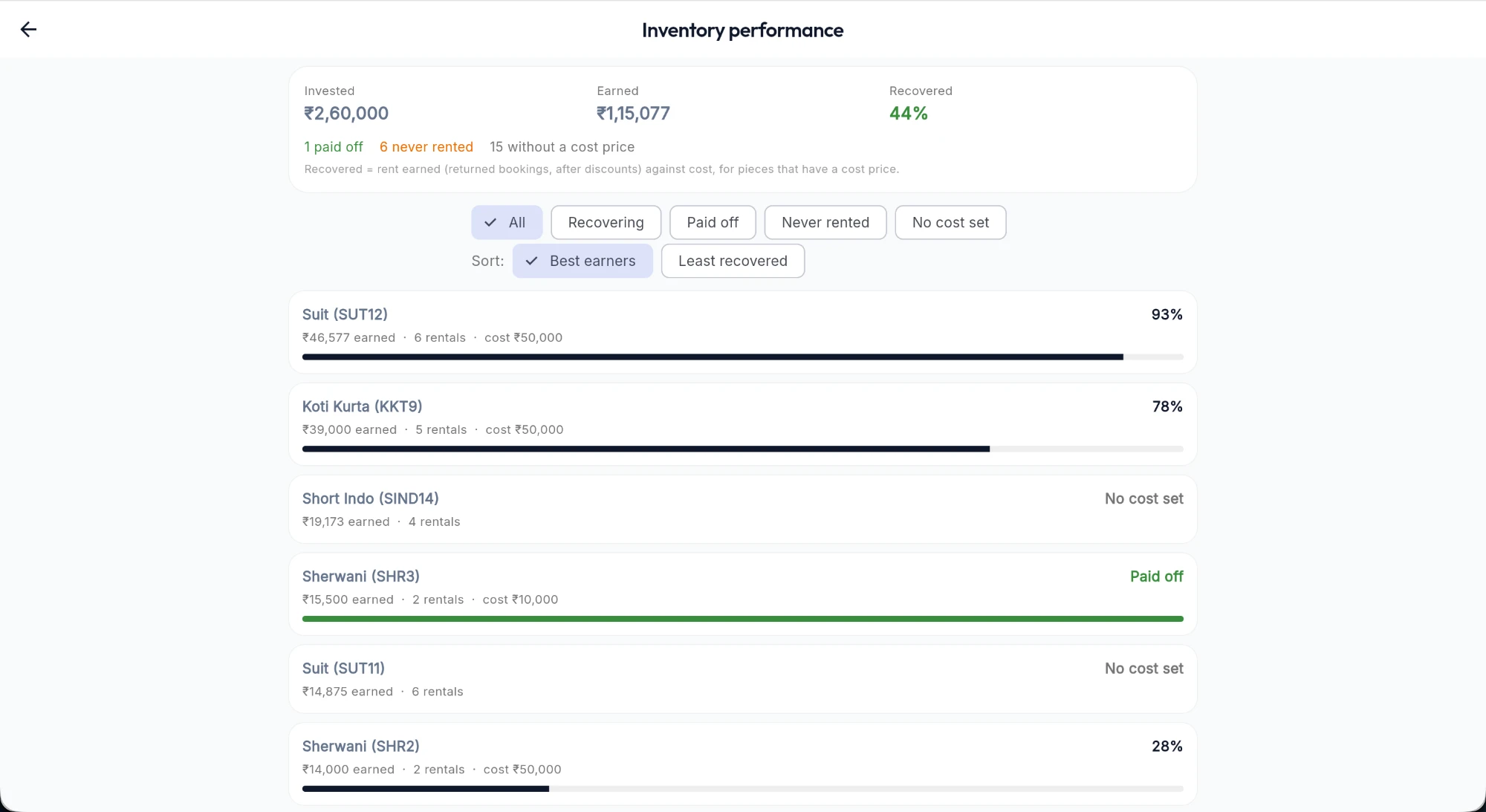
This is exactly the kind of decision per-item recovery data is for — not a gut feeling about which pieces "seem" popular, but an actual cost-versus-earned number per piece that tells you plainly whether a lehenga has paid for itself yet, and how its performance compares to others in the same tier. A catalog without that visibility tends to keep the same underperforming pieces in rotation indefinitely, because nobody ever sits down and actually runs the numbers — and tends to keep buying more of what feels popular rather than what the data shows is actually earning.
Once a piece is clearly underperforming for its tier, there are three honest options: reprice it down a tier if it's been consistently mispriced, retire it from active rental and sell it outright at a discount to recover remaining value, or — if it's a style issue rather than a price issue — accept that it was the wrong buy and let that inform what you purchase next, rather than keep discounting it indefinitely hoping demand catches up.
Common pricing mistakes
Pricing every piece in a tier identically. Two ₹20,000 lehengas in the same tier can have very different real demand — one a popular color and cut, another a style that barely moves. Flat tier-wide pricing with no room for individual adjustment leaves money on the table for the popular piece and over-prices the slower one.
Copying a competitor's number without knowing their cost structure. A shop pricing lower than you might simply have bought the same piece for less, or might be accepting a thinner margin than makes sense for your business. Matching their price without knowing why they set it is a guess dressed up as market research.
Treating the deposit as a pricing afterthought. A mispriced deposit — too low to cover real risk, or inconsistent across similar pieces — undermines a rental pricing strategy that otherwise looks disciplined on paper.
Never revisiting a price after it's set. A price that made sense when a piece was new and trendy might not make sense a year later, in either direction — demand data should periodically feed back into price, not just the original acquisition cost.
Frequently asked questions
How do I price a brand-new lehenga with no rental history yet? Start from the tier framework above based on its acquisition cost and occasion category, then treat that as a starting price to be adjusted once you have a few months of actual booking data for it — not a number you set once and never revisit.
Should my security deposit equal the full replacement cost of the piece? Not necessarily the full amount, but it should scale with it rather than being a flat number applied across very different price tiers — the goal is covering realistic risk, not matching 100% of acquisition cost on every single booking.
How often should I actually review my prices? A seasonal review — before and after wedding season, at minimum — is a reasonable cadence for most boutiques. Reviewing more often than that is rarely necessary unless a specific piece's performance clearly demands it.
Does GST affect how I should price my rentals? It can affect your net margin depending on your registration status and how rental income is classified for tax purposes — which is genuinely worth confirming with a CA rather than general advice, since this is an area with some real ambiguity. What's true regardless of the exact rate: if you're GST-registered, build that into your margin calculations rather than treating the rental price as pure pre-tax revenue.
Should I offer a discount to repeat customers? A modest, consistent repeat-customer or referral benefit (a small discount, or a bonus like Vastram's own "Founding 50" approach of locking in price and adding a referral bonus) tends to build the kind of word-of-mouth a wedding-season business runs on — the key word being consistent; an ad hoc discount negotiated differently with every customer erodes trust faster than it builds loyalty.
What if a competitor is renting the same style for noticeably less? Before matching them, it's worth asking what that price actually covers — if it doesn't account for cleaning, damage reserve, and real cost recovery, it may not be a price you can sustainably match either. Competing on visible differentiators (condition, service, deposit fairness, how fast you respond) is often more durable than a price race to the bottom on a thin-margin rental.
The actual point
Pricing a rental catalog well isn't about finding one perfect number per piece — it's about having a consistent framework (a tier, a ratio, a deposit logic) applied the same way every time, and the per-item data to know when a piece has stopped earning its place in that framework. A shop that can answer "is this piece actually profitable" with real numbers, not a feeling, is making pricing decisions that compound — and one that can't is pricing on instinct and finding out the hard way, usually after a full season has already gone by.
That per-item cost-versus-earnings visibility, along with the deposit tracking and booking system that keep a rental catalog's numbers honest in the first place, is exactly what Vastram was built to handle. If you're working through your own catalog's pricing and want to see how the numbers look on real inventory, the features overview and a short demo are both a few clicks away.